
Materials & Interiors — Petravo Journal
Most objects enter a room with a date attached. Petrified wood carries a different measure of time. What began as a tree was buried, transformed through mineralisation and preserved as stone. Its grain remains recognisable, while its weight, colour and surface belong to the mineral world. The result is a material that seems to hold two histories at once.
For contemporary interiors, that tension is precisely the appeal. In a space defined by straight lines, smooth walls and carefully controlled light, a singular natural object does something a manufactured accessory cannot: it introduces an element that was never designed to conform.
Beyond the decorative object
The language of luxury interiors has changed. It is no longer enough for a piece to be expensive, polished or instantly recognisable. What matters increasingly is whether it brings a sense of character and an authentic relationship to material. Petrified wood answers that question through its physical presence rather than an applied motif.
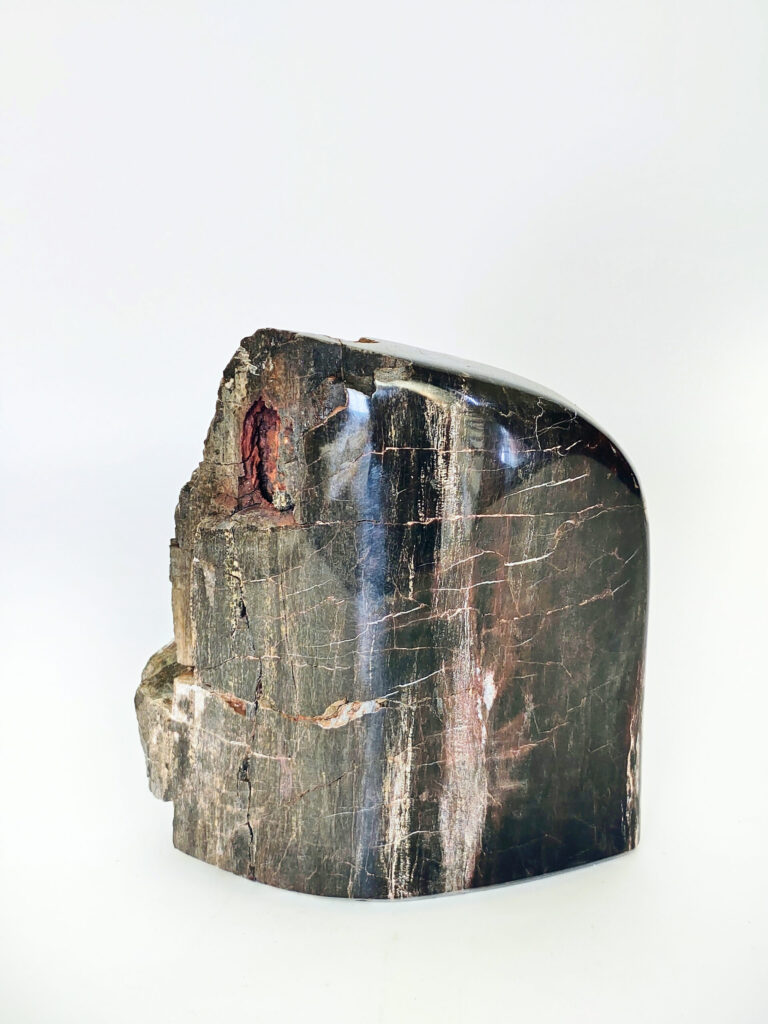
Look closely and the attraction becomes more specific: a fractured edge against a luminous mineral surface; a dark mass interrupted by a warmer seam; a silhouette that looks different from every angle. These details are not variations selected from a catalogue. They are the reason each individual piece exists as it does.
When contrast becomes composition
One of the most effective settings for petrified wood is a restrained room. Against limewashed walls, warm timber, architectural concrete or brushed metal, its irregular contours become more legible. The material does not need to dominate. A well-placed object on a console, a plinth or a low table can establish a focal point without crowding the space.
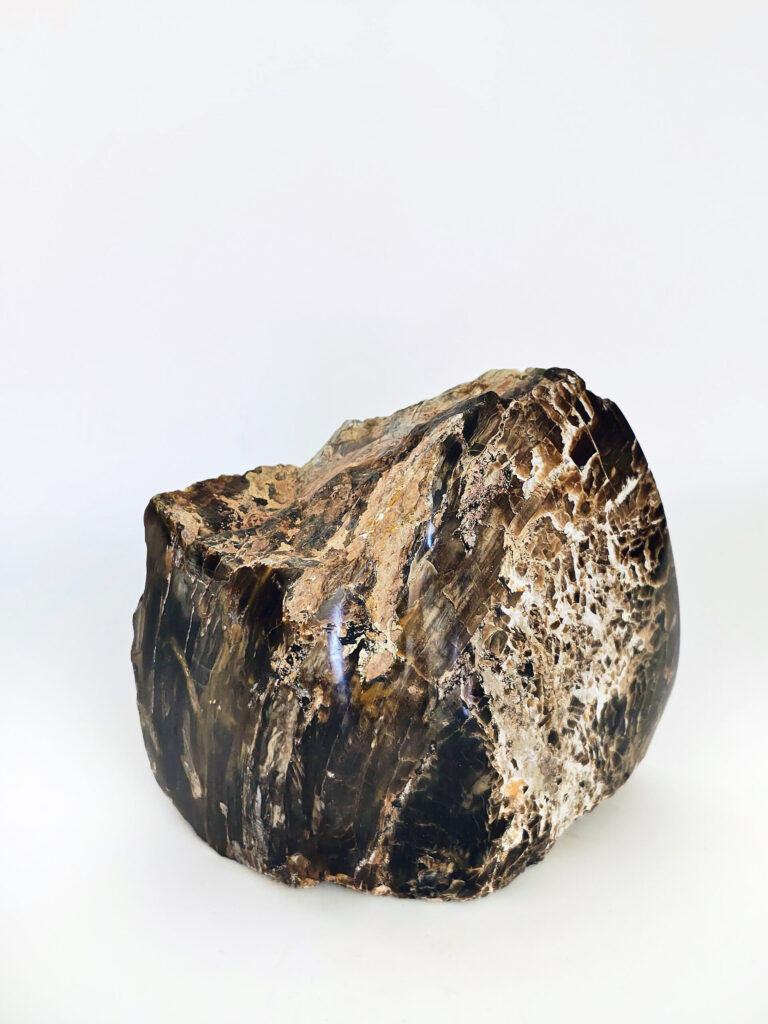
Placement is a matter of proportion. A small work can create intimacy on a shelf; a larger one benefits from distance and space around its outline. Side lighting can reveal texture and mineral transitions, while subdued surroundings allow the object’s form to carry the visual story. Heavy pieces, of course, require appropriately rated supports and considered installation.
The appeal of what cannot be repeated
Manufactured design offers precision, repeatability and the comfort of a known result. Natural material offers something else: specificity. Two works may share a family resemblance, but they cannot share the same internal history. That distinction matters to collectors and to designers seeking interiors that feel personal rather than assembled from interchangeable pieces.
At Petravo, the intention is to treat petrified wood as an art material, not simply as a decorative commodity. The individual structure of each piece guides how it is presented and finished. The hand of the artisan and the history of the material are not competing stories; the strongest work allows both to remain visible.
A slower way of choosing
Choosing a distinctive object asks for a different rhythm from ordinary shopping. Consider the room’s light at different hours. Think about the relationship between the piece and the materials already present. Ask whether it should create contrast, reinforce a colour story or quietly anchor a composition. Above all, allow the object to have a place rather than simply filling an empty surface.
For architects, interior designers and collectors, this opens the door to a more collaborative process: discussing scale, placement and the character of a particular work before deciding what belongs in a space.
Explore the collection
Explore original works such as Noir Fossil Arch, Golden Flame Relic and Ancient Pedestal. For interior projects, sourcing and bespoke conversations, contact Petravo.
Original photography and works: Petravo. Editorial: Petravo Journal.